Super Scratch Programming Adventure!
My parents bought my first computer for me in 1981. I was 11. When my TRS-80 Color Computer was turned on, it booted up into a BASIC editor. What it did afterward was up to me. That computer came with a whopping 4K (not a typo, K) of RAM and no storage. We bought a cable to connect the computer to a cassette tape deck so that I could store programs on cassettes. It took several minutes to load an entire program into memory.
I’m feeling nostalgic, but this article is not about that computer. It is about learning to program as a kid. I learned BASIC because I didn’t know anything else existed. I had this cool machine and I wanted to bend it to my will, to make it do my bidding. It started with simple things like accepting text input and repeating it on the screen. Later I learned how to save a Christmas card list and print it using an early dot matrix printers, the DMP-100, which had a really amazing 5×7 matrix (which meant no true descending characters, those ys and gs and stuff all got moved up and looked weird…sorry, feeling nostalgic again).
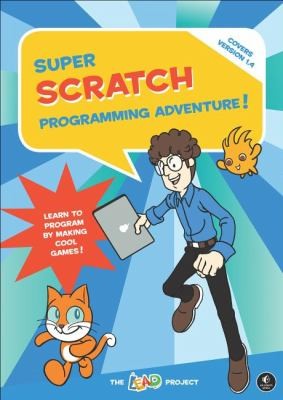
Super Scratch Programming Adventure! provides a much easier and extremely fun entry into programming. It doesn’t make the learner focus on the really gritty details, like people in my generation had to do. That’s okay. What it does do is give kids a way to do the parts that I loved about owning a computer in the early 1980s, it gives them a chance to bend it to their will, to make the computer do what they want it to do.
I have three kids, ages 6, 9, and 10. Each of them has read this book. Each of them enjoyed the clever comic narrative that introduces each chapter. Each of them, even the youngest, found the book enjoyable and interesting as well as easy to understand and follow. The software used for programming, Scratch, is freely available from MIT, where it was created, and runs on several platforms including our family’s beloved Ubuntu. I installed it on their computer and off they went. They haven’t finished the book or the exercises yet, but they are doing what I did as a kid, having fun with a powerful toy that they can control.
The meat of the book is impressive. It covers some deep topics but always remains readable and clear for those within its target audience, which according to a note on the back cover is “for ages 8 and up.” I admit it, my 6 year old is advanced
I’ve given away other programming books to kids, like the time a few years ago when I gave my nephew a book on game programming in Python. Starting now, this will be the book I recommend or give away to kids (to be followed later with Python or other stuff…). If you know a kid or even a young teen who wants to make their computer do stuff, this is a good start.
Disclosure: I was given my copy of this book by the publisher as a review copy.